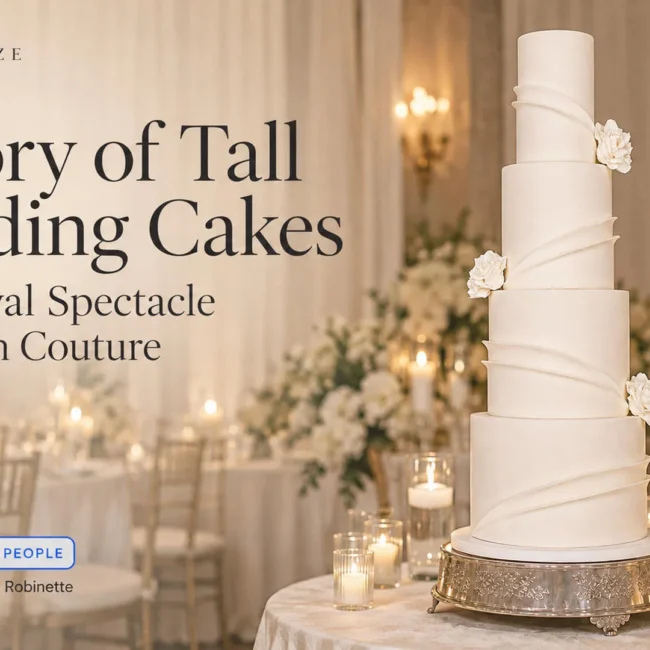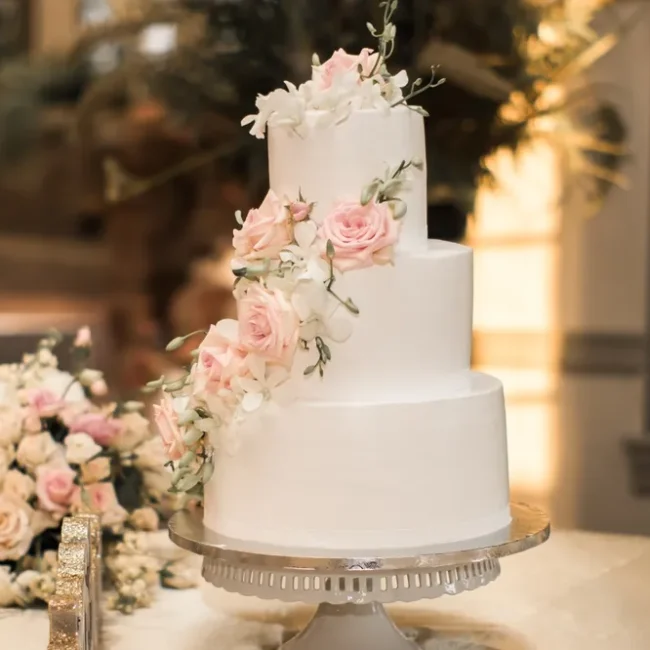

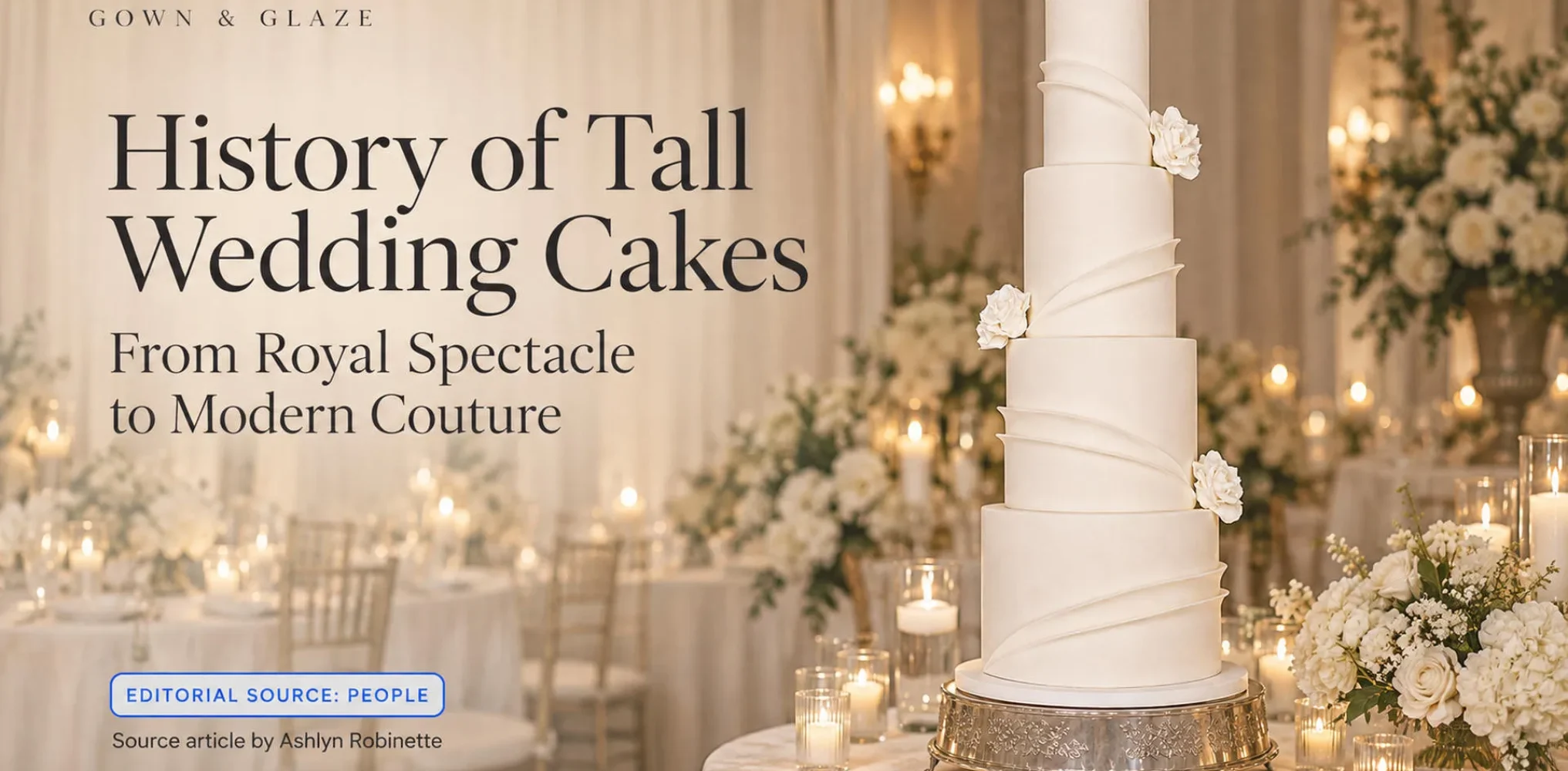
There is something almost architectural about a tall wedding cake.
Before anyone tastes it, the cake establishes a presence in the room. It creates a vertical line above the tablescape, catches the eye from across a ballroom and becomes part of the visual language of the celebration.
But the History of Tall Wedding Cakes is much more interesting than simply “cakes got bigger.”
The towering wedding cake emerged gradually—from ceremonial breads and bride pies to enormous royal cakes, decorative sugar structures, fully edible tiers and eventually the carefully engineered cakes modern artists can design today.
The subject recently received renewed attention in PEOPLE’s feature “How the Wedding Cake Became a Towering, Tiered Tradition” by Ashlyn Robinette. Robinette is identified by PEOPLE among its Weddings & Parents writer/reporters, making her coverage part of the publication’s dedicated wedding journalism.
For us at Gown & Glaze, that history feels especially relevant because the modern tall wedding cake is once again becoming something more than dessert. It is returning to its role as spectacle—but now with far more freedom for personal expression.
Before the Tower, There Was Ritual
The wedding cake did not begin as a beautifully iced stack of sponge layers.
The Royal Collection traces one early predecessor to ancient Rome, where bread was broken over a bride’s head as a gesture associated with good fortune for the newly married couple.
Centuries later, English wedding celebrations often centered on something quite different from today’s cake.
During the 16th and 17th centuries, the bride pie was common. These could be savory, highly elaborate dishes rather than desserts. Over time, enriched breads and pies gradually gave way to richer “plum cakes,” similar to what we would now call fruit cake. English Heritage notes that these cakes were increasingly covered with sugar icing, with the whiteness of the finished icing reflecting the quality—and expense—of refined sugar.
The important point is that wedding food was already communicating something beyond flavor.
Ingredients, decoration and scale could signal prosperity, ceremony and social position.
Height would eventually become part of that vocabulary.
Queen Victoria Made the Wedding Cake a Spectacle
Any serious look at the History of Tall Wedding Cakes eventually arrives at February 10, 1840.
Queen Victoria married Prince Albert that day, and their principal wedding cake demonstrated just how important scale had become.
The Royal Collection records the cake as approximately three meters in circumference and around 300 pounds. It was decorated with allegorical figures, orange blossom, myrtle and representations of Victoria and Albert dressed in classical costume.
It was extraordinary.
But there is an important distinction.
Queen Victoria’s cake was enormous without yet being the familiar vertically stacked, fully edible wedding cake we picture today.
In other words, scale came before height.
That distinction helps explain how wedding cakes evolved. Bakers and confectioners first made cakes grander through size and surface decoration. Creating genuine vertical architecture required another level of technical development.
1858: The Illusion of the Tall Tiered Cake
The next important chapter came with Queen Victoria’s eldest daughter.
When Victoria, Princess Royal, married Crown Prince Friedrich of Prussia in 1858, her wedding display included a three-tier composition. But according to English Heritage, only the lower tier was actually cake.
The upper levels were decorative sugar structures.
This is a fascinating moment in cake history because the desired aesthetic had already arrived before the engineering had completely caught up.
People wanted height.
They wanted grandeur.
They wanted the dessert table to rise upward and command attention.
Sugar artistry could create the visual effect, even when an entire multi-level structure could not yet be made practically from cake.
The wedding cake was beginning to behave like architecture.
1882: When the Tiers Finally Became Cake
The turning point generally associated with the recognizable multi-tiered British wedding cake came in 1882, when Queen Victoria’s youngest son, Prince Leopold, Duke of Albany, married Princess Helen of Waldeck-Pyrmont.
Food historian Carol Wilson’s history of the wedding cake identifies Prince Leopold’s wedding as a major milestone: each stacked tier consisted of actual iced cake rather than decorative sugar structures sitting above one edible layer. The firm icing between levels helped prevent the weight of the upper tiers from sinking into those below.
English Heritage likewise describes Prince Leopold’s wedding as the point by which all the tiers were made from cake.
A contemporary account later described his wedding cake as nearly six feet tall.
That is when the History of Tall Wedding Cakes becomes recognizable to the modern eye.
A cake was no longer merely decorated to suggest height.
The cake itself could become the tower.
The Secret Behind Taller Cakes Was Structure
Once wedding cakes began moving upward, artistry alone was not enough.
Gravity became part of the design process.
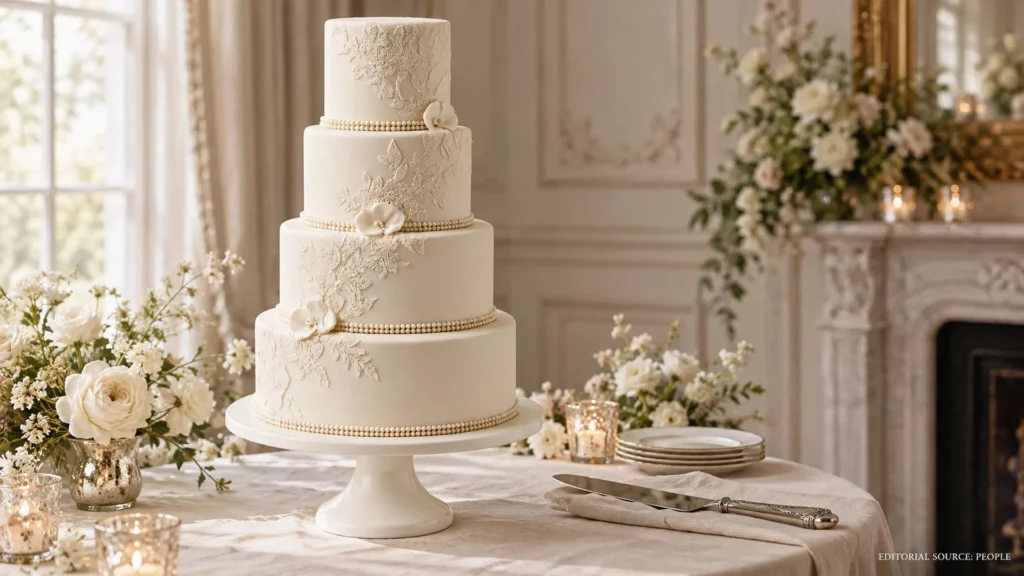
Early stacked cakes relied on very firm icing between layers. By the beginning of the 20th century, separate tiers supported by columns became increasingly practical. English Heritage notes that early versions could use surprisingly simple structural solutions before more sophisticated cake-support systems developed.
That engineering principle has never disappeared.
A dramatic wedding cake may appear delicate from across a reception room, but tall cake design depends on decisions guests never see:
internal supports,
tier dimensions,
cake density,
weight distribution,
temperature,
transportation,
assembly and
the relationship between real and display tiers.
That hidden structure is part of what separates a successful towering cake from a design that simply photographs well.
Royal Weddings Made Height Part of the Cultural Imagination
Royal celebrations continued to reinforce the idea that a wedding cake could function as a monument.
When Princess Elizabeth married Philip Mountbatten in 1947, their official wedding cake reached approximately nine feet high and had four tiers, according to English Heritage. Ingredients had to be sourced during a period of postwar rationing, contributing to its famous reputation as the “10,000 Mile Cake.”
By then, a towering cake meant more than abundance.
It represented ceremony.
Its scale helped transform the wedding breakfast or reception into an occasion visually different from an ordinary dinner.
That legacy still shapes what happens when a six-foot cake enters a modern ballroom.
The room changes around it.
From Status Symbol to Personal Statement
For much of wedding-cake history, height communicated wealth, status and formality.
Modern couples have considerably more freedom.
A cake can still be tall and ceremonial, but it does not need to imitate a royal wedding. Height can now serve the couple’s aesthetic rather than a predetermined social convention.
A tall contemporary cake might be:
- sculptural and almost undecorated,
- covered with couture-inspired pleating,
- finished with intricate vintage piping,
- separated with architectural spaces,
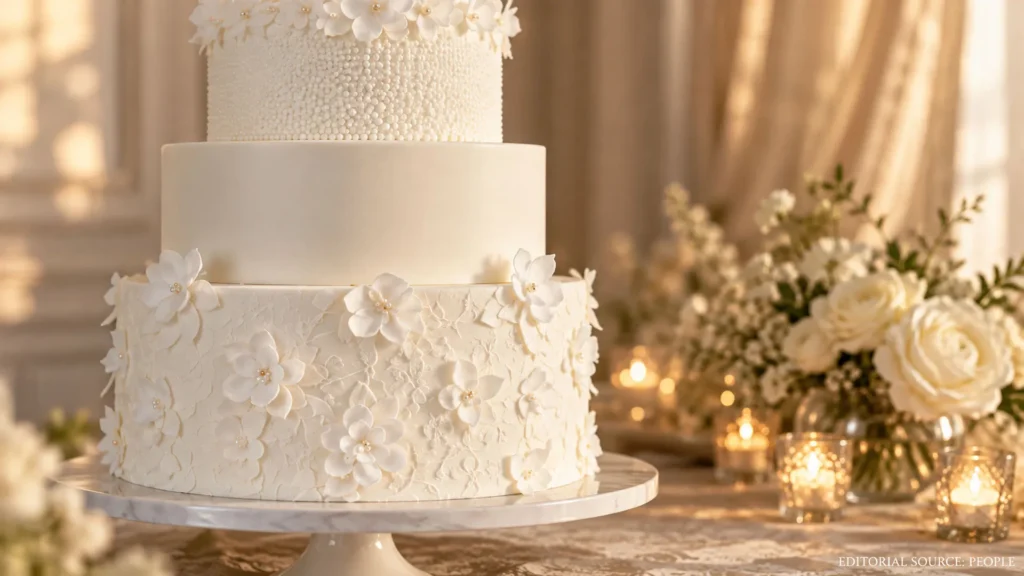
- wrapped in sugar flowers,
- inspired by lace or embroidery,
- dramatically asymmetrical, or
- designed as several narrow tiers that emphasize vertical movement.
This is where history becomes especially interesting.
The form survived, but the meaning changed.
Why Tall Wedding Cakes Are Captivating Couples Again
Towering cakes have returned to the current wedding conversation.
The Knot’s 2026 wedding-cake trend reporting describes cakes becoming larger and more experimental in scale, including dramatic tiered structures and designs approaching ceiling height. Industry cake artists interviewed for the report point to renewed interest in cakes that function as genuine reception centerpieces.
At the same time, the strongest contemporary designs are not simply recreating Victorian cakes.
Modern couples are borrowing the presence of historic cakes without necessarily borrowing their rules.
The result might combine an old-world silhouette with minimalist finishing.
Vintage columns might appear beside contemporary sugar flowers.
A formally tiered composition might carry texture inspired by a modern bridal gown.
The cake can reference history while still looking entirely of its moment.
Nikoo Vahdat and the Modern Cake Artist’s Perspective
At Gown & Glaze, Nikoo Vahdat’s role as cake design artist places the modern tall cake within a very different creative context from its Victorian predecessor.
Gown & Glaze approaches wedding cakes as custom artistic projects rather than predetermined templates. Its published design philosophy connects cake structure and decoration with the couple’s gown, venue, flowers, color palette and overall celebration.
That matters enormously when designing vertically.
Height by itself does not create luxury.
Proportion does.
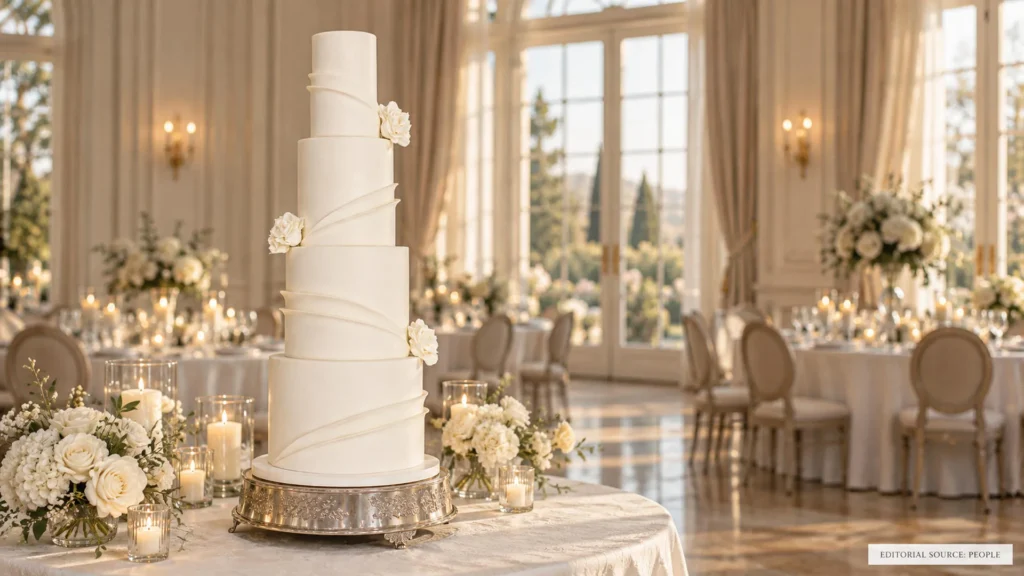
A six-tier cake in a grand ballroom can feel perfectly balanced. The same silhouette in an intimate garden setting may overwhelm everything around it.
Likewise, adding tiers simply to make a cake taller can produce a composition that feels repetitive. Each level should contribute to the rhythm of the design.
From the Gown & Glaze design perspective, the real question is therefore not:
“How tall can we make the cake?”
It is:
“What should this cake become within the complete visual composition of the wedding?”
That distinction turns height from a gimmick into a design tool.
Cake Artist Perspective — Nikoo Vahdat
Rather than treating tier count as a formula, Gown & Glaze’s cake-artistry approach considers the cake’s silhouette, spacing, finishing, flavor requirements, presentation and relationship to the surrounding wedding design.
For a couture-inspired cake, those relationships can become especially detailed.
A cathedral-length veil might suggest vertical movement.
Structured corsetry might inspire precise architectural tiers.
Pearl embellishment might become delicate edible detailing.
A gown’s draping could move upward or diagonally across several levels.
Floral appliqué might become dimensional sugar work.
The goal is not to reproduce the gown literally. It is to understand its design language and translate that language into cake.
Gown & Glaze’s published work describes this connection between bridal fashion and bespoke cake artistry as a central part of its creative approach.
Why a Tall Wedding Cake Can Transform a Reception
Wedding planners often think about scale throughout the room.
The floral installation has scale.
The tables have scale.
The ceiling has scale.
The dance floor and lighting have scale.
The wedding cake should be considered in the same way.
A tall cake can work beautifully when it creates a deliberate visual relationship with its surroundings.
In an expansive Southern California ballroom, additional height can prevent the cake from disappearing beside large floral installations.
At an estate wedding, a narrow sculptural cake can echo columns, archways or architectural proportions.
At a modern resort, negative space between tiers can make the composition feel lighter and more contemporary.
At a coastal celebration, a cleaner vertical silhouette can create presence without competing with the landscape.
This is why the History of Tall Wedding Cakes still matters to couples designing weddings today.
Understanding where the tradition came from makes it easier to decide which parts deserve to remain.
How Tall Should Your Wedding Cake Be?
There is no historically correct number of tiers—and no luxury rule requiring more.
Instead, consider several relationships together:
The venue.
A large room with high ceilings can visually absorb more height.
The guest count.
Serving requirements matter, although display and serving structures do not always have to be identical.
The cake table or pedestal.
A beautifully proportioned cake can lose its impact when placed on a surface that is too large, too small or visually disconnected from it.
The floral design.
A towering floral installation may call for a cake with enough visual strength to hold its own.
The gown.
The bridal look can inspire proportion, texture and movement without needing to be copied literally.
The photography.
Consider how the couple will stand beside the cake and how the full composition will appear in both close photographs and wide reception images.
The design itself.
Sometimes three beautifully proportioned tiers create more drama than six tiers added only for height.
From Royal Icing to Edible Couture
The History of Tall Wedding Cakes is ultimately the story of wedding design itself.
The cake began as ritual.
It became a symbol of abundance.
Royal celebrations turned it into spectacle.
Sugar artists gave it height.
Structural innovation made those tiers genuinely edible.
And modern cake designers transformed the form again—this time into something deeply personal.
At Gown & Glaze, that final chapter is the most exciting one.
Today’s couple does not need a tall cake because tradition says a wedding should have one.
They can choose one because the height, silhouette, flavor, texture and craftsmanship make sense for their celebration.
That is a much more interesting reason for a cake to reach toward the ceiling.
Frequently Asked Questions About the History of Tall Wedding Cakes
Who created the first tiered wedding cake?
There is no single inventor of every form of tiered wedding cake. However, Prince Leopold’s 1882 royal wedding is an important milestone in the development of the modern British multi-tiered cake because all of its stacked tiers were actual cake rather than decorative sugar structures above one edible layer.
Was Queen Victoria’s wedding cake tiered?
Queen Victoria’s 1840 wedding cake was extraordinarily large—approximately 300 pounds and about three meters in circumference—but it was not the fully edible, vertically stacked tiered cake that later became familiar. Its importance lies particularly in its scale, elaborate white decoration and enormous cultural visibility.
Why did wedding cakes become so tall?
Height developed partly because elite and royal weddings used cakes as displays of prosperity, craftsmanship and ceremony. Improvements in icing, structural support and baking eventually allowed genuinely stacked cakes to become increasingly ambitious. Modern tall wedding cakes use height less as a strict status symbol and more as an artistic and spatial design choice.
Are tall wedding cakes trending again?
Yes, although modern interpretations vary considerably. The Knot’s 2026 trend research identifies renewed interest in oversized, large-format and dramatic tiered cakes, including exceptionally tall designs. Contemporary couples are also combining historic references with sculptural, personalized and unconventional forms.
Does a tall wedding cake need every tier to be edible?
Not necessarily. The appropriate construction depends on servings, design, venue conditions, transportation and presentation requirements. A professional cake artist can determine how the visible structure and actual serving plan should work together safely and elegantly.
The Next Chapter of the Tall Wedding Cake
From Queen Victoria’s enormous royal centerpiece to Prince Leopold’s fully edible tiers and the sculptural cakes appearing at contemporary celebrations, wedding cakes have repeatedly evolved alongside fashion, architecture, technology and culture.
Today, the most compelling tall wedding cakes do something the historic examples could not.
They can be completely individual.
Gown & Glaze brings together Nikoo Vahdat’s cake artistry and couture-informed design thinking to create custom wedding cakes connected to the couple, the gown, the venue and the full visual story of the celebration. The studio serves weddings across San Diego, Orange County and Los Angeles.
For couples considering a towering wedding cake, the starting point should not be a number of tiers.
Start with the story you want the room to tell.
Then build upward.
Explore Gown & Glaze’s custom wedding cake experience and schedule a design consultation to develop a cake created specifically for your celebration.
Editorial Source Credit
Historical editorial inspiration: Ashlyn Robinette, writer/reporter covering Weddings & Parents for PEOPLE.
Read Robinette’s PEOPLE feature: “How the Wedding Cake Became a Towering, Tiered Tradition”
Cake artistry perspective: Nikoo Vahdat, Cake Design Artist, Gown & Glaze. Gown & Glaze identifies Nikoo as part of the creative team behind its custom, couture-inspired wedding cakes.
Historical references: Royal Collection Trust, English Heritage and Gastronomica were used to verify significant milestones in the development of royal and tiered wedding cakes.